

Defined process cycle
Heating, a minimum two-hour holding phase and controlled cooling are assessed through recorded temperature data.
EN 14179-1:2016
CSi provides documented calibration assessment of heat-soak process systems used for heat-soaked thermally toughened soda lime silicate safety glass.
Why calibration matters
EN 14179-1:2016 requires the heat-soak process system to be calibrated. The calibration establishes whether the oven and its defined loading arrangement can deliver the specified process cycle.
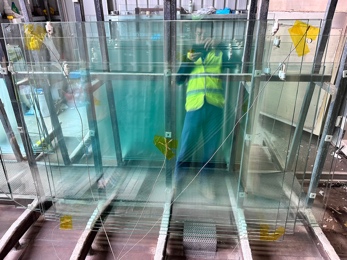
The assessment considers the oven, glass support and separation arrangement as a system. Thermocouples are placed in good thermal contact with selected glass surfaces, and the resulting temperature record is evaluated against the standard’s calibration criteria.
Calibration does not eliminate every possibility of spontaneous breakage and does not, by itself, certify the finished glass. It provides documented evidence about the performance of the assessed heat-soak process system in its calibrated configuration.
The reference standard
Glass in building — Heat soaked thermally toughened soda lime silicate safety glass — Part 1: Definition and description.
Heating, a minimum two-hour holding phase and controlled cooling are assessed through recorded temperature data.
Load, glass separation, separator details and stillage configuration are recorded because they affect airflow and heating performance.
Control-element and glass-surface temperatures, key times and the assessed configuration are documented for review.
What the assessment examines
The calibration record must show how the assessed system performs through the complete heat-soak cycle—not only the oven’s displayed set point.
Glass-surface temperatures are measured at defined positions while the oven progresses from ambient conditions until the last measured glass surface reaches the required threshold.
The recorded cycle is reviewed to confirm the glass surfaces remain within the specified holding-temperature range for the required duration.
The cooling phase and control-element temperature are recorded so the cycle can be evaluated against the defined process conditions.
CSi service
Before attendance, CSi confirms the oven arrangement, proposed test load and the information needed to prepare for the calibration. At the site, the loading arrangement and measuring positions are documented and the calibration cycle is witnessed and recorded.
The resulting report identifies the assessed oven and configuration, records the relevant cycle information and states the outcome against the applied calibration criteria. Any type-approval documentation is issued only where applicable to the agreed service and satisfactory results.
Plan the calibration
CSi will review the available information, explain the preparation requirements and provide a quotation for the proposed service.